
In the world of healthcare administration, "good enough" is never the standard. Whether you are navigating billing audits, managing HIPAA privacy protocols, or streamlining clinical workflows, compliance and quality go hand in hand.
CQI is not a one-time project or a reaction to a compliance audit. It is a deliberate, ongoing culture of assessing workflows, identifying inefficiencies, and implementing data-driven solutions. Whether you operate a multi-facility hospital system, a specialized outpatient clinic, or a rural private practice, CQI serves as your roadmap to safer patient outcomes and optimized operational health.
So, this month our focus is how to make Continuous Quality Improvement (CQI) and its critical, inseparable partner: comprehensive clinical documentation “contagious”.
Relying on patchwork fixes when a process breaks down often leads to repeat violations and administrative burnout. In the ever-evolving healthcare landscape, providing excellent patient care is just one piece of the puzzle. How we evaluate, refine, and sustain that care determines our long-term success.
By adopting a formal, structured CQI framework, your organization can proactively find errors, cut waste, and protect compliance standards, but it takes having positive energy and the right attitude so it becomes “contagious”.
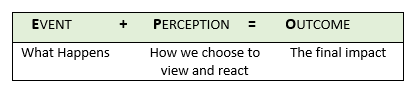
The Equation That Changes Everything: E + P = O
The formula Event + Perception = Outcome (E+P=O) is a powerful framework for personal leadership and wellness. Jack Canfield popularized this concept to show that while we cannot always control the Events (E) in our lives, our Perception (P) of those events completely determines the Outcome (O).
In healthcare, where the environment is fast-paced, unpredictable, and highly regulated and highly emotional, this formula shifts us from a reactive state to a proactive mindset. It reminds us that our greatest power lies not in the circumstances we face, but in the lens through which we view them.
How It Works in Everyday Care
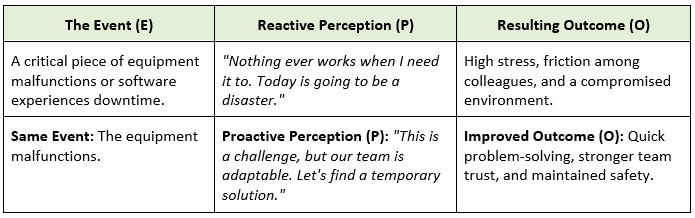
When an unexpected Event occurs, such as a sudden change in a patient's status, short-staffing, or a complex new digital protocol, it creates an instant fork in the road. The outcome depends entirely on the middle variable (P):
Start Now - 3 Ways to Practice E + P = O
- Pause Before Reacting - When a chaotic event hits, give yourself a three-second buffer. Ask yourself: "How can I frame this so I can move forward constructively?"
- Shift from "Why Me?" to "What Now?": Avoid getting stuck in frustration over things you cannot change. Instead, redirect your focus to your next strategic step.
- Practice Collective Reframing: Encourage your team to pause during high-stress moments. A shared commitment to a positive focus can transform a difficult shift into an inspiring display of teamwork.
True transformation in healthcare begins not with a new policy, but with a shared purpose—and leadership is the spark that ignites it. When leaders bring authentic, positive energy and a forward-thinking attitude to the floor, they do more than manage; they inspire.
This vibrant mindset reframes continuous quality improvement (CQI) from a series of clinical checklists into a deeply rewarding mission to elevate patient care.
When excellence is modeled with passion and resilience, it becomes contagious.
The Power of Process
The Linchpin of CQI: Clinical Documentation
You cannot improve what you do not accurately measure. In healthcare, data begins with the clinical record. Accurate, high-quality documentation bridges the gap between daily clinical actions and macro-level quality performance.
If CQI is the engine of healthcare improvement, clinical documentation is the fuel. Comprehensive clinical documentation is the precise, chronological, and highly detailed recording of a patient's medical history, clinical observations, diagnostic tests, treatment plans, and outcomes. Beyond its legal and administrative necessity, high-quality documentation serves as the ultimate communication channel among multidisciplinary healthcare teams
.
The "Golden Rules" of High-Quality Documentation
CQI and clinical documentation exist in a symbiotic relationship. An organization cannot improve what it does not measure, and it cannot measure what it does not document.
To drive clinical excellence, records must adhere to strict data standards, often summarized by the acronym CCEA, as adapted out of regulatory guidelines in regulatory data integrity frameworks in clinical research and pharmaceuticals:
- Complete: Includes all relevant facts, baseline data, and clinical reasoning behind decisions.
- CQI Application: If a hospital is trying to reduce patient readmission rates, a "complete" dataset must include not just successful discharges, but also patients who left against medical advice, electronic health record (EHR) corrections, and subsequent follow-up logs. If a clinic deletes "outlier" data to make their performance look better, the data is no longer complete, leading to flawed quality interventions.
- Consistent: Data must be uniform, follow standardized protocols, and be recorded in a logical, chronological sequence with aligned timestamps.
- CQI Application: When measuring "door-to-balloon" time for cardiac patients, consistency means every clinician across different shifts marks the start and end times using the same definitions and synchronized system clocks. There must be a reliable, sequential audit trail showing when information was modified so that the timeline of patient care makes logical sense.
- Enduring: Data must be recorded on a durable, stable medium that preserves its quality, safety, and readability throughout its entire required lifecycle.
- CQI Application: Quality improvement initiatives often require longitudinal studies spanning several years to evaluate long-term patient outcomes. "Enduring" data ensures that electronic records do not become corrupted during server migrations, digital media formats do not become obsolete, and physical records (like paper tracking sheets) do not fade, tear, or deteriorate.
- Available: Data must be readily accessible, searchable, and retrievable by authorized personnel whenever it is needed for review, audits, or real-time decision-making.
- CQI Application: A CQI committee cannot successfully run a Plan-Do-Study-Act (PDSA) cycle if they have to wait weeks for an IT department to manually extract data. "Available" data means that frontline quality coordinators, compliance auditors, and clinical staff can log in and immediately review up-to-date performance dashboards to identify safety threats or operational bottlenecks.
When documentation lacks authentication, is incomplete or vague, CQI metrics suffer. Consider how robust documentation directly impacts quality improvement across all healthcare settings:
- Patient Safety & Transitions: Clear communication in the EHR prevents medication errors, tracking failures, and dangerous gaps during patient handoffs between departments or external facilities.
- Accurate Quality Reporting: National quality programs, registries, and hospital rating systems rely entirely on coded data derived from provider notes. Poor documentation leads to artificially low-quality score
- Data-Driven Workflows: To fix a bottleneck—such as emergency department wait times or delayed specialist referrals, teams need reliable timestamps and structured data to isolate the root cause.
- Audit Readiness & Revenue Integrity: Comprehensive charts naturally defend against payer audits, minimize medical necessity denials, and justify the complexity of care provided.
Simple Steps to Foster a CQI Mindset
Fostering a Continuous Quality Improvement (CQI) mindset in healthcare isn't about enforcing strict rules, as mentioned above, it is about inspiring a culture of curiosity and collaboration. When frontline staff feel empowered to fix everyday problems, patient care naturally improves. Here are five simple steps to inspire a CQI mindset in your team:
1. Start with the "Why"
- Focus on patients: Connect every quality initiative back to patient safety, comfort, or saving time. Avoid framing it around checkboxes or administrative metrics.
- Make it personal: Help staff see how a smoother process reduces their own daily frustrations and burnout.
2. Celebrate the "Small Wins"
- Highlight micro-improvements: Do not wait for a massive, hospital-wide success to praise your team.
- Publicly recognize effort: Call out a nurse who found a faster way to organize supplies, or a clerk who streamlined patient check-ins. This builds momentum and shows that small ideas matter.
3. Shift from "Blame" to "Systems"
- Normalize mistakes: When a process fails, treat it as a data point rather than a personal failure.
- Ask "How," not "Who": Instead of asking "Who messed up?", ask "How did our current process allow this mistake to happen?" This psychological safety encourages staff to report issues early.
4. Empower Frontline Problem Solving
- Involve the experts: The people doing the daily work know the bottlenecks best. Never hand down solutions from the top without consulting them.
- Keep it simple: Introduce basic, non-intimidating tools like the PDSA (Plan-Do-Study-Act) cycle. Encourage them to run tiny, low-stakes experiments to test their ideas.
5. Lead by Example
- Be visible and accessible: Walk the floor, ask questions, and actively listen to feedback.
- Show your own learning curve: Admit when an idea you championed didn't work out, and openly share what you learned from it. This models the exact adaptability you want to see.
Practical Applications
Building a culture of continuous improvement does not require a massive budget. It requires a structured approach to problem-solving. Consider implementing these steps in your organization:
- Adopt a Framework: Utilize proven methodologies like the PDSA (Plan-Do-Study-Act) cycle. Small, iterative tests of change prevent organizational fatigue and yield manageable data.
- Engage Multidisciplinary Teams: Quality is not just an administrative task. Bring together physicians, nurses, medical assistants, billers, and coders to get a 360-degree view of operational friction points.
- Bridge the Coding/Clinical Divide: Foster regular communication between your clinical staff and your documentation improvement (CDI) or coding teams. Shared understanding leads to more precise charts.
- Celebrate Small Wins: Did a new template reduce chart-closure times by 10%? Share that success. Positive reinforcement builds long-term momentum.
Elevating Compliance & Quality: Which CQI Framework is Right for Your Team?
Here is a breakdown of three industry-standard CQI frameworks and how they apply directly to compliance and healthcare administration.
3 Formal CQI Frameworks for Healthcare Leaders
1. PDSA (Plan-Do-Study-Act)
The operational engine of CQI is the Plan-Do-Study-Act (PDSA) cycle, a four-step iterative model used for testing system changes. It is a rapid, four-step cycle used to test small-scale changes and implement iterative improvements.
Plan: Identify a process that needs improvement, define the objectives, and map out a strategy.
Do: Implement the change on a small, controlled scale (e.g., a pilot study in a single ward).
Study: Analyze the results and compare data against the baseline to see if the change caused an improvement.
Act: If successful, implement the change broadly. If not, refine the approach and begin the cycle again.
PDSA is best used for testing a new workflow or a specific compliance corrective action plan (CAP) before rolling it out organization-wide.
- In Practice:
- Plan: You notice a high rate of missing signatures on intake forms and plan a new digital prompt.
- Do: Test the digital prompt with a small team of three providers for one week.
- Study: Review the data to see if missing signatures decreased.
- Act: If successful, implement the prompt across the entire clinic; if not, refine the plan and try again.
2. Lean Methodology
The core concept is centered entirely on maximizing value by eliminating "waste" (such as unnecessary waiting, redundant paperwork, or extra steps).
- Best Used For: Streamlining overly complex administrative processes, like credentialing, billing cycles, or patient onboarding.
- In Practice:
- Mapping out your current medical billing workflow to identify where claims get stuck.
- By removing duplicate review steps, you reduce the time it takes to submit clean claims without sacrificing audit accuracy.
3. Six Sigma
This core concept is a data-driven, highly structured approach focused on reducing variation and eliminating defects using the DMAIC framework (Define, Measure, Analyze, Improve, Control).
- Best Used For: High-stakes, high-volume processes where even a tiny error rate can cause massive financial or legal liabilities.
- In Practice:
- Analyzing coding error rates across a large hospital system.
- Six Sigma uses precise statistical analysis to pinpoint exactly why specific coding errors happen and locks in tight controls to prevent them from recurring.
How to Choose Your Framework
- Choose PDSA if you need a quick, flexible way to test a localized solution without a massive upfront time investment.
- Choose Lean if your team feels bogged down by bureaucratic bottlenecks and you need to make workflows faster and more efficient.
- Choose Six Sigma if you have access to robust data and need to solve a deeply rooted, complex systemic error.
By anchoring your compliance initiatives in a formal CQI framework, you move your organization from a culture of reactive firefighting to proactive excellence (the topic of an October Blog Article coming soon).


APPEALS MANAGEMENT
Online Training
with the option to certify online
REVENUE CYCLE MANAGEMENT
Online Training
with the option to certify online
CLINICAL DOCUMENTATION IMPROVEMENT
Online Training
with the option to certify online
CONDUCTING INVESTIGATIONS
Online Training
with the option to certify online

AUDITING FOR COMPLIANCE
Online Training
with the option to certify online
HIPAA COMPLIANCE
Online Training
with the option to certify online
CORPORATE COMPLIANCE
Online Training
with the option to certify online
Online Training
with the option to certify online
Online Training
with the option to certify online
COMPUTERIZED PROVIDER ORDER ENTRY
Online Training
with the option to certify online
HIPAA FOR MANAGED
SERVICE PROVIDERS
Online Training provided by

Certification provided by the American Institute of Healthcare Compliance.
How to Earn .25 Continuing Education Unit by reading the Monthly Newsletter

- Login as a Member
- Click on My Renewals from your DashBoard
- Click on FREE CEUs for your next credential renewal!