
The Importance of Statistical Significance
Written by Joanne Byron, LPN, BS, CCA, CIFHA, CHA, COCAS, CORCM, CHCO, HPOC, OHCC, CMDP, ICDCT-CM/PCS
Information provided below is a basic overview of standard deviation when Auditing for Compliance and quality standards. It is not intended as being comprehensive, legal or consulting advice. You may be interested in other auditing articles – click here.
Introduction
In an increasingly data-driven corporate healthcare environment, auditing has moved beyond traditional spot-checking to advanced analytics. Standard deviation, a statistical measure of dispersion, has become an essential tool for auditors to assess risk and operational performance. By quantifying how data points, such as transaction amounts, process times, or product quality metrics deviate from the mean, auditors can identify anomalies, measure volatility, and evaluate the consistency of operational processes.
This paper explores how standard deviation helps audit financial risk by identifying outliers and market volatility, and how it improves operational efficiency by highlighting process variations.
Why Standard Deviation (SD) is Vital
In simpler terms, standard deviation measures the variation in the data. A higher variance requires a larger sample size to achieve statistical significance. It represents the average amount of variation or dispersion of data points from the mean.
Standard deviation is another measure of dispersion that complements variance. Standard deviation indicates how spread out the data points are in relation to the mean. Just like variance, standard deviation helps us understand the consistency and reliability of the data.
- SD helps to identify outliers and anomalies. Auditors use standard deviation to pinpoint unusual data points that fall far from the mean to flag potential fraud, waste, billing errors, patient waiting times and quality measures.
- SD is used to assess consistency. In auditing, a small standard deviation indicates consistent performance, while a high one suggests unreliable processes or high variability.
- Calculating SD is vital when used in evaluating treatment/clinical variation. It helps determine if outcomes are consistent across a population. High standard deviation in medical data indicates inconsistent patient responses, which may signal a need for audits on clinical quality.
Understanding Risk and Performance
Financial risk management requires understanding volatility and uncertainty. Standard deviation serves as a proxy for this risk, helping auditors and financial analysts determine the potential for loss or unpredictability.
Auditors are tasked with providing assurance on financial statements and improving business processes. While averages (means) provide a central reference point, they often disguise underlying inconsistencies or high-risk outliers.
Standard deviation (SD) is essential because it measures the spread of data; a small standard deviation indicates consistency, while a high standard deviation indicates high variability. For auditors, this variability is synonymous with risk and potential inefficiency.
It is essential for auditing financial risk and operational efficiency because it permits auditors to see if "average" performance is due to uniform, acceptable results, or a mix of excellent and failing results.
Standard deviation is particularly useful for auditors due to its specific mathematical properties:
- Sensitivity to Outliers: Because standard deviation squares the variance, it heavily impacts outliers, making it an effective tool for surfacing extreme cases.
- Comparability (Scale Invariance): Auditors can directly compare the volatility of different datasets, even if they are in different units, allowing for comprehensive risk assessment across diverse business units.
- The Normal Curve (Bell Curve): In a normal distribution, roughly 68% of data falls within one SD, 95% within two, and 99.7% within three. Auditors can use these intervals to define "normal" transactions and immediately identify the 5% that are outliers.
While powerful, standard deviation has limitations that auditors must recognize:
- Assumes Normal Distribution: It works best with normal, bell-shaped curves. If data is heavily skewed or has fat tails, standard deviation might underestimate tail risk (rare but extreme events).
- Backward-Looking: It is based on historical data, which may not repeat in the future.
- Treats Volatility Equally: It treats positive and negative deviations equally, whereas auditors are primarily concerned with downside risk.
Steps to Calculate Sample Standard Deviation (SD)
Calculating standard deviation for a health care audit measures how much individual data points (e.g., patient wait times, billing errors) differ from the average, showing consistency in care. To calculate, find the average (mean), calculate each data point’s distance from the mean, square them, average those squares, and find the square root.
1. Calculate the Mean
- This is calculating the average by adding all audit data points and then dividing by the total number of items.
2. Calculate Deviations
- Subtract the mean from each individual data point.
3. Square the Deviations
- Square each result from step 2 to remove negative values.
4. Sum of Squares
- Add all squared values together.
5. Calculate Variance
- Divide the sum of squares (sample size minus one).
6. Calculate Standard Deviation
- Take the square root of the variance.
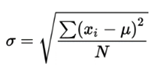
σ is the standard deviation, xi is each individual data point in the set, µ is the mean, and N is the total number of data points. In the equation, xi, represents each individual data point. The results are then summed (symbolized as Σ), which is the numerator of the fraction from the equation.
Example: Audit of Patient Wait Times (Minutes)
Data (patient wait times): 10, 15, 20, 25, 30
Mean is 20: (10 + 15 + 20 + 25 + 30) ÷ 5 = 100 ÷ 5 = 20
1. Deviations:
- 10 - 20 = -10
- 15 - 20 = -5
- 20 - 20 = 0
- 25 - 20 = 5
- 30 - 20 = 10
2. Squared Deviations:
- (-10)2 = 100
- (-5)2 = 25
- (0)2 = 0
- (5)2 = 25
- (10)2 = 100
3. Sum of Squares: 100 + 25 + 0 + 25 + 100 = 250
4. Variance: 250 ÷ (5 - 1) = 250 ÷ 4 = 62.5
5. Standard Deviation: 62.5 ~ 7.90569 (round to 7.91)
6. Audit Conclusion: The average wait time is 20 minutes with a standard deviation of 7.91 minutes
Conclusion
Understanding the significance of standard deviation is essential for modern auditing. It allows auditors to shift from a focus on the average to a focus on the variation. By providing a clear, quantified metric for variability, standard deviation allows auditors to quickly pinpoint financial risks and compliance issues that require investigation. Used alongside other audit tools, it ensures that companies can better manage risk, maintain control over processes, and optimize performance.
About the Author
Joanne Byron, BS, LPN, CCA, CHA, CHCO, CHBS, CHCM, CIFHA, CMDP, COCAS, CORCM, OHCC, ICDCT-CM/PCS is an educator with the American Institute of Healthcare Compliance, a Licensing/Certification non-profit partner with CMS. She shares her experience of over 40 years as a nurse, consultant, auditor, and investigator in the healthcare field.
References
AIHC
National Library of Medicine
Copyright © 2026 American Institute of Healthcare Compliance All Rights Reserved